
 How-to
Finding Gaming Venues as a New Resident: A Local Search Guide
Last Updated: November 17, 2026
Quick Summary
To find gaming venues as a new resident, search your map app with several terms like "game store near me" and "board game cafe," then save every promising result. Match the venue type to the games you play, and verify hours, age policy, and event schedules by phone or on the venue's latest event post.
- Search with several terms, not just one, and save every promising result in one list.
- Check hours and recent reviews, plus photos from the last few months.
- Board-game cafes suit casual drop-in play and mixed-experience tables.
- Community and recreation centers often run low-cost, all-ages game nights and chess clubs.
- Visit a venue during an open play night to meet regulars before paying for a league or membership.
Table of Contents
- Start With a Local Search Workflow for Gaming Venues
- Choose the Right Venue Type for Your Gaming Preference
- How to Connect With Local Gamers and Find Gaming Groups Near Me
- Your Next Step: Check One Venue This Week
- Frequently Asked Questions
Start With a Local Search Workflow for Gaming Venues
A simple search workflow can help you find gaming venues quickly. Start with your phone, a map app, and about 20 minutes.
Search terms matter. Try "game store near me," "board game cafe," and "gaming venue" in your map app, and save every promising result.
Next, check hours, recent reviews, and photos from the last few months.
- Search with several terms, not just one
- Save every promising result in one list
- Check hours and recent reviews
- Confirm listings by calling or visiting the site
Choose the Right Venue Type for Your Gaming Preference
Not every venue serves every gamer. Match the venue to what you play and how you like to play it.
List the games you play most and your preferred format: casual drop-in, scheduled league, tournament, or open-table role-playing. Then sort candidates into five types:
- Hobby and game stores. The default for tabletop, trading-card games, and miniatures. Many run open play nights and leagues for tabletop and card games.
- Board-game cafes. Best for casual drop-in groups and mixed-experience tables. Good for a first solo visit because you can join a posted open table without committing to a league.
- Esports lounges and LAN centers. Built for PC and console play with better hardware than most homes. Ask whether newcomer sessions exist before booking a long block.
- Arcades and family entertainment centers. Good for rhythm games, fighting games, and party-style play. The least structured option, so they work best when you already have one or two people to go with.
- Community and recreation centers. Libraries, parks-and-recreation departments, and community centers often run board-game nights, chess clubs, and teen gaming programs. The strongest option for newcomers who want a low-pressure, all-ages room.
A simple decision rule: to learn a game, start with a store or cafe; for competition, a store league or esports lounge; for free and low-pressure, a library or community center.
Watch out: venue categories blur. A comic shop may run a tournament scene, and a cafe may host a role-playing table, so confirm the actual schedule rather than trusting the label.
Before you commit an evening, verify posted hours versus event hours, drop-in versus preregistration, age policy, whether tables or stations must be reserved, what equipment is provided, and whether food or drink purchase is required. A quick phone call or a look at the venue's most recent event post answers most of these. To find tabletop gaming events near you, check event calendars at stores, libraries, and community centers; many post weekly game nights online and note whether newcomers are welcome. You can also see where tabletop gaming events are held and how to find them.
The five venue types differ in structure, cost of entry, and who they suit best.
| Venue type | Best for | Key difference |
|---|---|---|
| Hobby and game stores | Tabletop, card games, miniatures | Open play nights and leagues |
| Board-game cafes | Casual drop-in groups | Join posted open tables without a league |
| Esports lounges and LAN centers | PC and console play | Better hardware than most homes |
| Arcades and family entertainment centers | Rhythm, fighting, party-style games | Least structured; go with one or two people |
| Community and recreation centers | Low-pressure, all-ages play | Often free; board-game nights and chess clubs |
How to Connect With Local Gamers and Find Gaming Groups Near Me
Finding a venue is only half the job. You also want people to play with, and as a new resident you are starting without the social proof that long-time locals have.
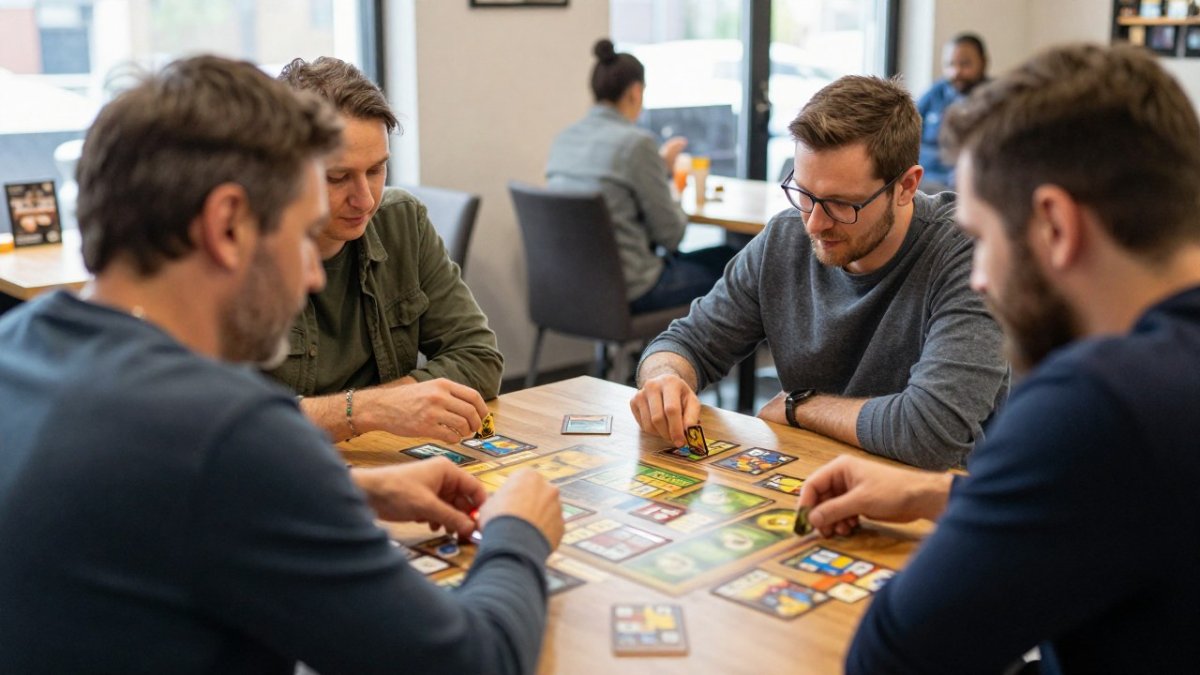
1. Work the venue before the internet. Attend one regular game night at a venue you have already verified. Our practical guide on how to connect with local gamers walks through each step. Arrive a few minutes early, ask staff which night draws the most regulars, and introduce yourself to the person running the event. Staff know which tables are welcoming and which groups are full.
2. Use online channels with a specific ask. Meetup, game-specific Discord servers, and local subreddits all work, but generic posts get ignored. Post a short introduction naming the game, format, your experience level, and the nights you are free, then ask one concrete question such as whether a table has an open seat.
3. Verify the group before you commit. Ask three questions before a first session: how many players usually show up, whether the group is beginner-friendly, and whether there is a cost or membership. For organized play, ask whether the venue enforces a code of conduct and how it handles disputes.
4. Check access and fit. Confirm accessibility for the space you will actually use (step-free entry, accessible restrooms, seating), the age policy if you are bringing family, and whether the group is explicitly inclusive of new players. Libraries and community centers are often the easiest starting point for a low-pressure, all-ages room. Integrating local community events into your routine becomes significantly more manageable when you utilize DexTrack to monitor nearby gatherings and player activity.
5. Close the loop. After a good session, ask the organizer how the group communicates between meetups, then join that channel the same week. That single step converts a one-off visit into a recurring circle.
Watch out: a venue can be busy and still be a poor fit. If a group is deep into a long campaign or a competitive ladder, a newcomer may wait weeks for a seat, so ask about open-table or beginner nights instead.
Our tip: visit a venue during an open play night the first time. You will meet regulars faster than by calling ahead, and you will see the room's real social tone before you invest in a membership or league fee. For a structured list of steps, see 7 Steps to Find Active Tabletop Gaming Groups.
Your Next Step: Check One Venue This Week
Pick one venue from your list and visit it this week. A single visit tells you more than hours of online research. Bring your favorite game and ask if there is a table open.
If you want a wider set of options to compare, browse comic shops, collectible stores, and gaming venues to see what is near you.
Frequently Asked Questions
How do I find new people to play games with after moving?
Start with a few channels at once. Check Meetup and Eventbrite for game nights, look for your city's subreddit and local Discord servers, and visit board game stores and cafés that host regular sessions. Ask staff which nights are most welcoming to newcomers. Attend one event, then return to the same group. Repeat visits build familiarity faster than one-off attendance, and most regulars are glad to introduce someone new to the table.
How can I tell if a gaming venue is actually open and active?
Before visiting, check the venue's recent social media posts, its event calendar, and its reviews from the past few months rather than older listings. Call ahead or send a message to confirm the schedule, especially for drop-in nights. Venue details change often, so a listing that has not been updated in a long time is a reason to verify first. Pricing and reservation policies also vary, so ask before you go.
What should I bring to my first gaming night at a new venue?
Bring a valid ID if the venue is 21+ or requires registration, a small amount of cash in case the venue does not take cards, and any game or accessories you own if the event asks for them. Arrive a few minutes early, introduce yourself to the organizer, and ask how the table or session works. Pricing depends on the venue, event, and whether you reserve a seat, so check the venue's website or contact them directly for current details.